


Not long ago, during one of my son’s club games, I noticed that the back of the opposing starter’s jersey seemingly featured the name “Musial.”
I approached the fence separating the bleachers from the field and asked our first base coach if that was indeed the case. Not quite getting my question, he scrolled through the game app and said, “Uhhh… looks like it’s Nathan.”
“No,” I said, “his last name. It’s the name of an all-time great.”
“Oh, really? That’s what the ump said about your kid.”
I’m guessing the coach is in his young 40s, so I wasn’t surprised that he didn’t recognize the names of Musial or Ott. Then again, I’m not that much older, and the names of pre-Expansion Era icons are as familiar to me as those of Judge, Ohtani, Trout and so on.
Even if I wasn’t the type to bury my nose in a baseball history book on a cold winter day, I’d likely have known about the old ballplayer with my name by virtue of growing up in New York City. I heard some form of the same question a fair amount, whether on a ballfield or from a friend’s grandparent: “Ott? Are you related to Mel?”
Early on, I learned that no, it wasn’t the case. Still, I always felt a kinship with my not-quite Uncle Mel, and back when my own big league hopes were still intact, I liked to think that somehow his abilities were passing down to me through some power born from our identical lettering.
I read a book about him a long time ago, but I decided to refresh myself a bit on his life and career. Hailing from Gretna, Louisiana, Ott joined the New York Giants at age 16 as a small but power-hitting catcher. Manager John McGraw converted the newcomer to an outfielder but resisted tinkering with his unusual swing, which included his hands dropping low and an exaggerated leg kick as he loaded. McGraw also refused to send Ott to the Minors, and kept him on the bench for much of his first two years.
The strategy paid off, as Ott slashed .322/.397/.524 in 124 games as a 19-year-old, before the monster breakout in 1929: a .328/.449/.635 line with 42 homers, 151 RBI and an NL-best 113 walks. With the short right field fence of the Polo Grounds proving an inviting target, Ott led the Senior Circuit in home runs six times, in walks five times, in OBP four times and in runs scored twice over the next 13 years. The final year of that stretch (1942) also marked Ott’s first as player-manager, and he continued in that capacity until bowing out as a player after 1947 and stepping down as manager halfway through 1948.
By both the traditional and many of the newer metrics, Ott is a no-doubt Hall of Famer. His 511 home runs were an NL record until Willie Mays surpassed him in 1966, and he’s one of only four players to accumulate at least 1,800 runs scored, 1,800 RBI and 1,700 walks. His 155 OPS+ is good for 29th all-time, and his 111 bWAR ranks 15th among all position players.
But what the numbers don’t convey is just how admired this guy was in his time. According to his SABR bio, when a cereal company held a contest to determine the most popular player at each position in 1938, Ott, who alternated between right field and third base that year, won at both positions. In 1944, he topped a poll for most popular sports hero of all time.
Ott was said to be genial to everyone, perhaps to a fault; after all, he was the target of Leo Durocher’s pointed (and usually misquoted) comment about nice guys finishing last. But Durocher also noted that even the rabid Brooklyn fans cheered for this member of the hated Giants, perhaps the ultimate stamp of Master Melvin’s likability.
There are probably a few reasons why Mel Ott’s legacy didn’t have the staying power it seemingly deserved. He doesn’t own any instantly recognizable records or distinctions, and even during his heyday he had to fight for headlines with the stars of the far more successful Yankee teams of Ruth, Gehrig and DiMaggio. He also wasn’t immortalized in song like DiMaggio, or Willie, Mickey and the Duke.
But he belonged to that strata of fame and adulation where he could have been. This is what I heard in the voices of the older men who asked if I was related to the literal and metaphorical Giant star of their youth. It was the remnants of the awe felt by those who saw Ott launch all those home runs with that unforgettable swing, its echoes surviving in scattered books and articles and in the memories of someone like me, linked to this Depression-era hero through the three letters of our name.
Nearly 80 years after he last suited up for the Giants, it’s hardly a shock to learn that a coach or another person who seemingly enjoys baseball hasn’t heard of Mel Ott. On the other hand, I’m always pleasantly surprised when another parent does know the name and we can talk for at least a little bit about the sport’s history or numbers.
And maybe someday, when my son is pressed up against a fence watching his son play, an ump or perhaps another old-timer lingering nearby will ask if the Ott boy is related to Mel. And the torch, diminished but not extinguished, will pass on for the next generation to caretake.
Thanks to Baseball Reference and its extraordinary research database, Stathead, for help in assembling this piece.
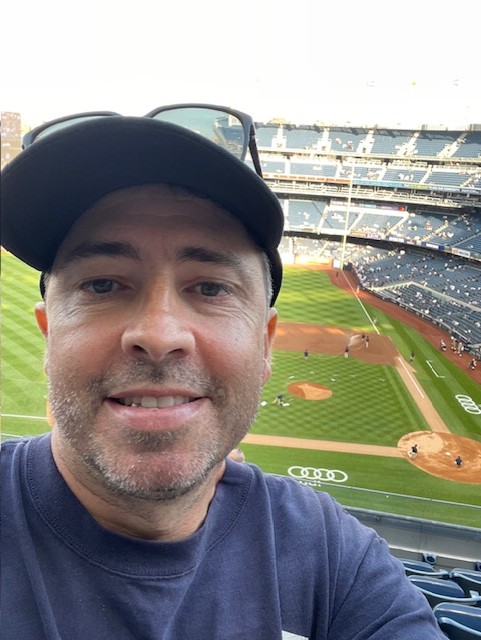
Tim Ott
Tim's early yearnings for baseball immortality began on the dirt and grass of the P.S. 81 ballfield in the Bronx. Although a Hall of Fame career was not in the cards, his penchant for reading the MLB record book and volumes of history tomes led to an internship with MLB.com in 2002. Tim fulfilled an array of roles over the next nine years at the company, from editorial game producer to fantasy writer and editor and reporter for MLB-related promotions. While a busy freelance writing career has since taken him in other directions, Tim has always kept baseball in his heart, and is happy to be back to observing and reflecting on our great pastime.